What is Expense Ratio in ETF? Complete Beginner’s Guide
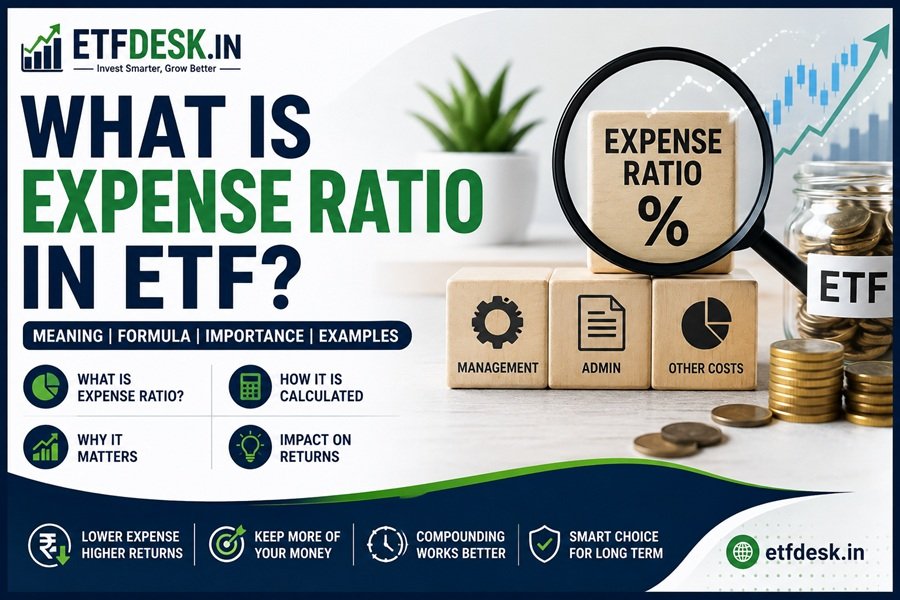
The Expense Ratio is one of the most key factors to check before investing in an ETF. It represents the annual fee charged by the fund house (AMC) to manage and operate the fund. Although ETF fee may seem small in comparison to various mutual fund, it is deducted from the fund’s assets every year and directly impacts your long-term investment returns.
For ETF investors, where the primary goal is to achieve market returns at a lower cost, choosing a fund with a competitive expense ratio can significantly improve wealth creation over time. Even a difference of 0.30%–0.50% annually can result in a substantial difference in long term wealth for returns over 10–20 years.
What is an Expense Ratio?
An Expense Ratio is the percentage of a fund’s total assets that is used each year to cover operating expenses.
These expenses include:
- Fund management fees
- Administrative expenses
- Registrar and transfer agent charges
- Custodian fees
- Audit and legal expenses
- Marketing and operational costs
What is a Good Expense Ratio?
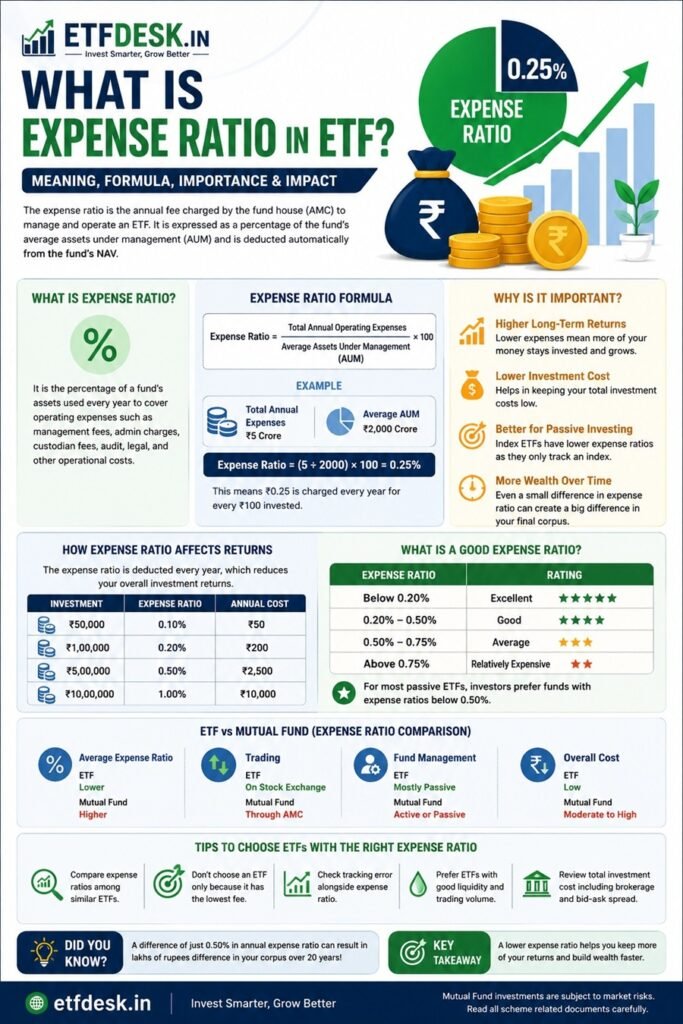
| Expense Ratio | Rating |
|---|---|
| Below 0.20% | Excellent |
| 0.20% – 0.50% | Good |
| 0.50% – 0.75% | Average |
| Above 0.75% | Relatively Expensive |
Check out All Indian ETF List here and watch Expense Ratio of Each ETFs.
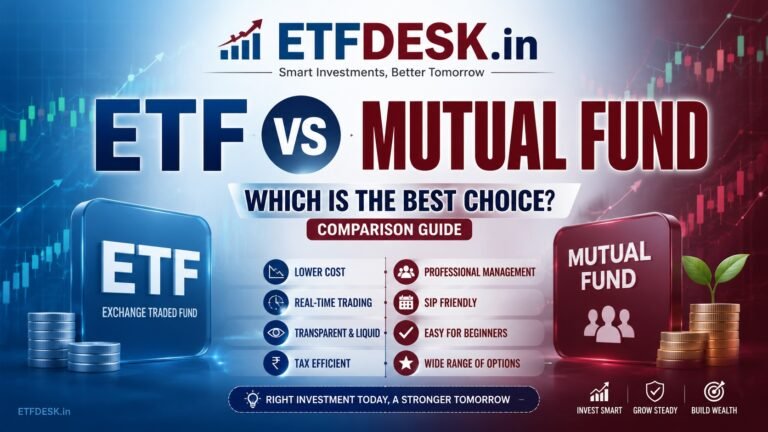
ETF vs Mutual Fund Expense Ratio
| Feature | ETF | Mutual Fund |
|---|---|---|
| Average Expense Ratio | Lower | Higher |
| Trading | Stock Exchange | AMC |
| Fund Management | Mostly Passive | Active or Passive |
| Overall Cost | Low | Moderate to High |
Since ETFs usually replicate an index, they require less active management and therefore have lower expenses.
Expense Ratio Formula
Expense Ratio = (Total Annual Operating Expenses ÷ Average Assets Under Management) × 100
Example
Suppose an ETF has:
- Total Annual Expenses: ₹5 Crore
- Average AUM: ₹2,000 Crore
Expense Ratio = (5 ÷ 2000) × 100 = 0.25%
That means investors pay ₹250 annually for every ₹1,00,000 invested, although the deduction happens daily through the ETF’s NAV.
Check out some of the top ETF Calculator which will surely help a lot
ETF Calculators
Free tools to plan your ETF investments.
How Does Expense Ratio Affect Returns?
The expense ratio is deducted every year, reducing your overall investment returns for more info kindly check out below example.
Example
| Investment | Expense Ratio | Annual Cost |
|---|---|---|
| ₹50,000 | 0.10% | ₹50 |
| ₹1,00,000 | 0.20% | ₹200 |
| ₹5,00,000 | 0.50% | ₹2,500 |
| ₹10,00,000 | 1.00% | ₹10,000 |
What is Expense Ratio in ETF – Infographic Image
Why is Expense Ratio Important?
Choosing a lower expense ratio offers several advantages.
1. Higher Long-Term Returns
Lower annual expenses mean a larger portion of your investment remains invested, allowing compounding to work more effectively.
2. Lower Investment Cost
ETFs are designed to be cost-efficient. A low expense ratio helps keep your investment costs minimal.
3. Better Passive Investing
Most index ETFs simply track an index instead of actively selecting stocks, allowing them to operate at lower costs.
4. More Wealth Over Time
Saving even 0.30%–0.50% every year can translate into lakhs of additional wealth over decades.
FAQ – Frequently Ask Questions
What is an expense ratio in an ETF?
The expense ratio is the annual percentage amount which to charge by fund house to manage and operate the ETF.
Is a lower expense ratio better?
Lower expenses allow investors to retain more of their investment returns over time.
How is the expense ratio deducted?
It is deducted daily from the ETF’s NAV
What is considered a good expense ratio for an ETF?
An expense ratio below 0.20% is generally considered excellent, while anything below 0.50% is typically viewed as competitive for most passive ETFs.