ETF vs Stocks: Which Should You Choose in 2026?
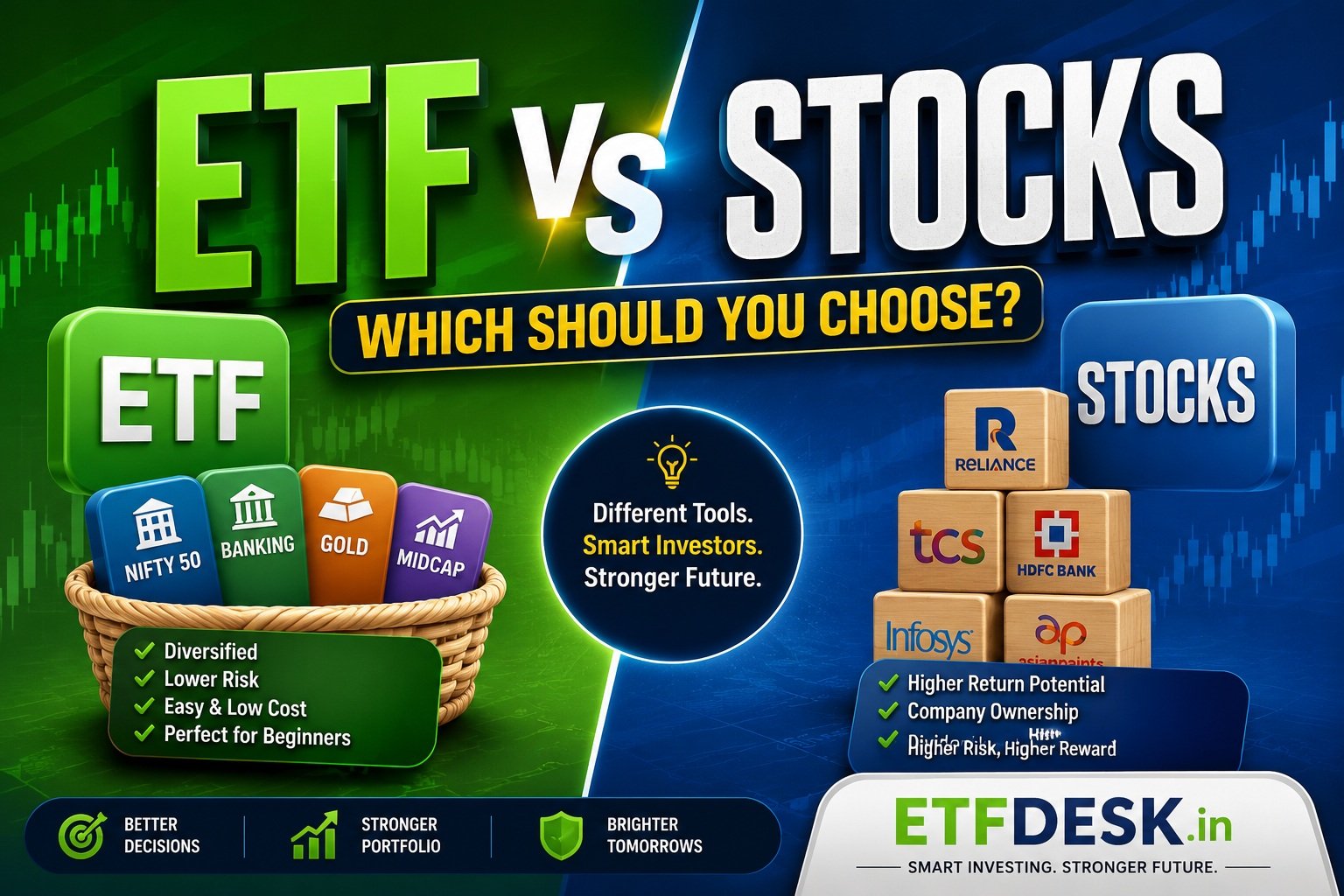
If you’re planning to start investing in the stock market, one of the biggest questions you’ll face is:
Should you invest in ETFs or individual stocks?
Both can help you build wealth, but they serve different purposes. Stocks can generate higher returns if you pick winning companies, while ETFs provide diversification and lower risk.
On This guide we explains everything you need to know about ETF vs Stocks Who are better in India ?, helping you decide which investment suits your financial goals.
What is an ETF?
An Exchange Traded Fund (ETF) is a basket of securities that trades on the stock exchange like a normal share.
Instead of buying one company, ETFs provide you to buy multiple companies through a single investment. Check out List of Best 10 ETFs in India for beginners.
For example:
- Nifty 50 ETF invests in the 50 largest Indian companies.
- Gold ETF tracks gold prices.
- Banking ETF invests in major banking stocks.
This makes ETFs one of the easiest investment options for beginners.
ETF Calculators
Free tools to plan your ETF investments.
What is a Stock?
A stock represents ownership in a single company.
Suppose you buy India’s Top market cap company of Reliance Industries shares, you become a shareholder of Reliance. If the company performs well, the stock price may rise significantly. If it performs bad, the value can decline sharply too.
Individual stocks offer the opportunity for higher returns but come with higher risk.
ETF vs Stocks: Quick Comparison
| Feature | ETFs | Stocks |
| Investment | Basket of companies | Single company |
| Risk | Lower | Higher |
| Diversification | High | None |
| Research Required | Low | High |
| Suitable For | Beginners | Experienced investors |
| Potential Returns | Moderate to High | Very High |
| Volatility | Lower | Higher |
| Expense Ratio | Small annual fee | No expense ratio |
| Long-Term Investing | Excellent | Good if chosen wisely |
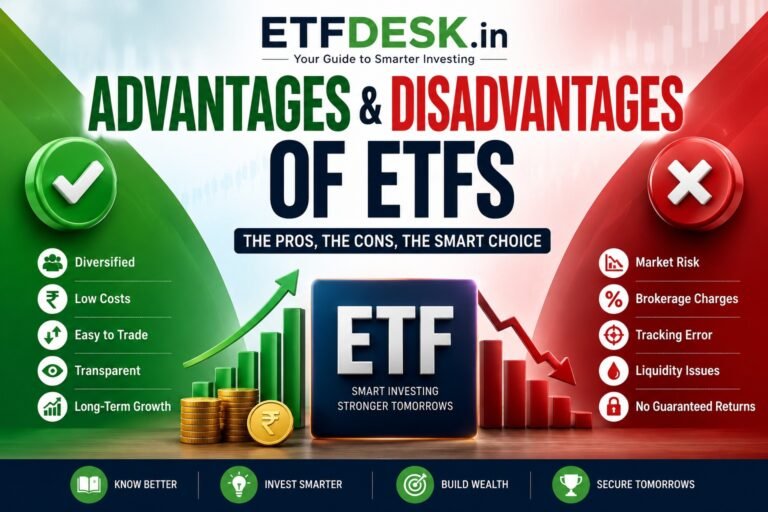
Advantages of Investing in ETFs
1. Instant Diversification
Buying one ETF can give exposure to dozens or even hundreds of companies.
Instead of purchasing 50 individual stocks, one Nifty ETF provides exposure to all of them.
2. Lower Risk
Since money is spread across multiple companies, poor performance by one company has less impact on your investment.
3. Easy for Beginners
You don’t need to analyze financial statements, quarterly results, or management quality for dozens of companies. If ETF are down you can easily Average it too. Check out ETF Average calculator which will help you in geting to know ETF average price per unit.
Simply choose a quality ETF.
4. Low Cost
Most ETFs have expense ratios between 0.05% and 0.50%, making them among the cheapest investment products.
5. Passive Investing
ETFs follow an index automatically, so there’s no need for active stock selection.
This saves both time and effort.
Advantages of Investing in Stocks
Higher Return Potential
A successful company can generate extraordinary returns.
Examples include:
- Infosys
- Tata Consultancy Services (TCS)
- Reliance
- State Bank of India
- HDFC Bank
- Asian Paints
- Bajaj Finance
Many quality stocks have delivered returns much higher than market indices over the long term.
Dividend Income
Many companies distribute part of their profits as dividends.
Dividend-paying stocks can create a regular income stream while also offering capital appreciation.
Ownership in a Business
Buying stocks means owning a portion of the company.
As the business grows, shareholders benefit from increasing profits and rising stock prices.
Risks of ETFs
Although ETFs are considered safer, they still carry some risks. if Market are crash ETF also down.
Market Risk
If the overall market falls, ETFs also decline.
Tracking Error
Some ETFs may not perfectly match the index they follow.
Lower Return Potential
Since ETFs own many companies, exceptional gains from one company have less impact on the overall return.
Risks of Stocks
Investing in individual stocks involves higher risk. Although ETF also some disvantages but in comparing to single stocks ETF are far better.
Company-Specific Risk
Poor earnings, management issues, or industry problems can significantly reduce a stock’s value.
High Volatility
Individual stocks often experience larger price swings than diversified ETFs.
Research Requirement
Successful stock investing requires understanding company fundamentals, financial statements, valuations, and industry trends.
Return Comparison
Historically:
| Investment | Typical Long-Term Annual Return* |
| Broad Market ETF | 10%–15% |
| Quality Individual Stocks | 12%–20%+ |
| Poor Stock Selection | Negative returns are possible |
*Historical performance does not guarantee future results.
The higher potential return from stocks comes with greater risk.
ETF vs Stocks for Beginners
If you’re new to investing:
✅ ETFs are usually the better starting point because they offer:
- Diversification
- Lower risk
- Easy management
- Lower emotional stress
- Consistent long-term growth
Many successful investors begin with ETFs before gradually adding individual stocks.
ETF vs Stocks for Long-Term Investors
For long-term wealth creation:
Choose ETFs if you:
- Want steady wealth creation.
- Prefer lower risk.
- Don’t have time for research.
- Like passive investing.
Choose Stocks if you:
- Can research businesses thoroughly.
- Can tolerate higher volatility.
- Aim to outperform the market.
- Have a long investment horizon.
Can You Invest in Both?
Absolutely.
Many experienced investors combine ETFs and individual stocks.
A balanced portfolio might look like this:
- 70% in diversified ETFs for stability.
- 30% in carefully selected quality stocks for higher growth potential.
This balance approach giving your portfolio the opportunity to outperform the market. But if you are beginners then we recommend you to starts investment journey with ETF rather then buying single stocks.
Who Should Choose ETFs?
ETFs are ideal if you:
- Are a beginner investor or Gen-Z.
- Want passive investing.
- Prefer lower risk.
- Have limited time for market research.
- Are investing for retirement or long-term goals.
Who Should Choose Stocks?
Stocks are better if you:
- You can analysis stocks fundamental and technical knowledge.
- Can handle market volatility.
- Want higher return potential.
- Have experience with investing.
- Can remain invested through market cycles.
Frequently Asked Questions (FAQs)
Are ETFs safer than stocks?
Yes. ETFs are generally safer because they invest in multiple companies, reducing company-specific risk.
Can ETFs make you rich?
ETFs can build substantial wealth over time through disciplined investing and compounding, but they typically won’t produce the explosive gains that a few exceptional individual stocks sometimes achieve.
Which gives better returns: ETFs or stocks?
Individual stocks can deliver higher returns, but they also carry higher risk. ETFs generally offer more stable, market-linked returns.
Should beginners invest in ETFs or stocks?
Most beginners are better served by starting with ETFs due to their diversification, simplicity, and lower risk.
Can I buy ETFs and stocks together?
Yes. Combining ETFs and carefully selected stocks is a common strategy that balances diversification with growth potential.
Final Verdict
There is no single “best” choice—your decision should match your goals, knowledge, and risk tolerance.
If you’re new to investing or want a hands-off approach, ETFs are an excellent foundation for long-term wealth creation.
If you’re willing to able research companies and accept higher volatility then individual stocks may provide greater return potential.